

Amplifier
Amplifier in synthesis is called Voltage Controlled Amplifier or VCA. It shapes the volume of the sound. It is designed to move all the time and rapidly. It has specific modulator attached to it called Envelope.

Envelope
Envelope in this sense shouldn’t be confused with an Envelope in Compressor. Envelope in compressor calculates an average over time of the amplitude of the sound going through it.
Envelope in Synthesis runs the set path every time a key is pressed. It controls how the volume of the amplifier changes over time. It’s controlled by 4 parameters:
- Attack Time
- Decay Time
- Sustain Level
- Release Time
Picture: Figure 1
A – Attack Time
When we talk about attack when it comes to synthesizers we are actually talking about Attack Time – how long it takes for sound to go from zero to full value in the amount of time we set it to, every time we press the key. The more you increase the attack time, the slower it’s going to ramp up. If I increase the attack time, it actually dulls the beginning of the note. The more you decrease the attack time the quicker it’s going to get to the full value. If I decrease the attack time the hit of the note will be sharper. Please see Figure 1.
D – Decay Time
The sound gets to its peak and then it moves to a Sustain Level. The time it takes to get from the full value to Sustain Level is Decay Time. See Figure 1.
S – Sustain Level
The Sustain Level represents kind of a steady state the note stays at while it’s being held. Sustain is the only value not relating to time but to a level. It represents the level the note stays on while it’s being held until the release of the key. See Figure 1.
R – Release Time
Release Time is amount of time it takes for the sound to get to zero from Sustain Level after we release the key. The longer the Release Time the longer the sound lingers after we release the key. The shorter the Release Time the shorter the sound lingers after we release the key. See Figure 1.
Things to Remember
ADSR – represent 4 values of an Envelope:
- A – Attack Time is the time it takes to get from zero to full value when you press a key.
- D – Decay Time is the time it takes to get from full value down to the Sustain Level.
- S – Sustain Level is the level or a steady state the note stays at while it’s being held.
- R – Release Time starts when you release the key and the release time is the amount of time it takes to get from the sustain level down to zero.
Switch Envelope
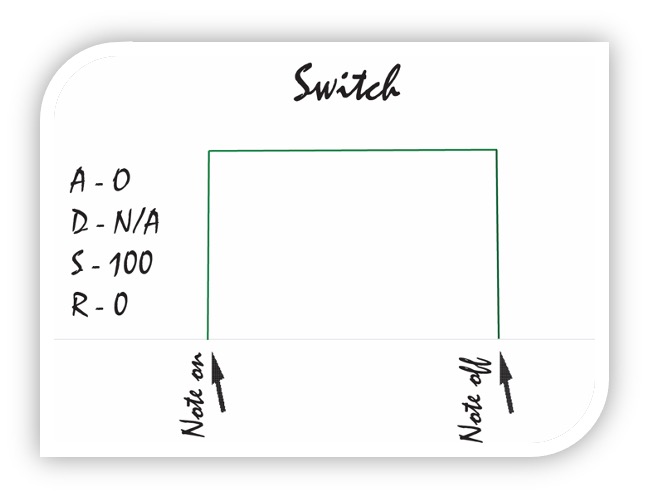
This envelope can be used to replicate the sound of for example a Hammond Organ. Or whenever you need the sound to get to the full value as fast as possible when you press the key, and need it to stop playing as fast as possible when you release the key. A – 0, D – 0 or very low, S – 100%, R – 0. See Figure 2.
Picture: Figure 2
Troubleshooting
This setting can create a click at the beginning and the end of the note. If that happens set Attack and Release Times to a value a little bit above zero.
Percussive and Damped Percussive Envelope
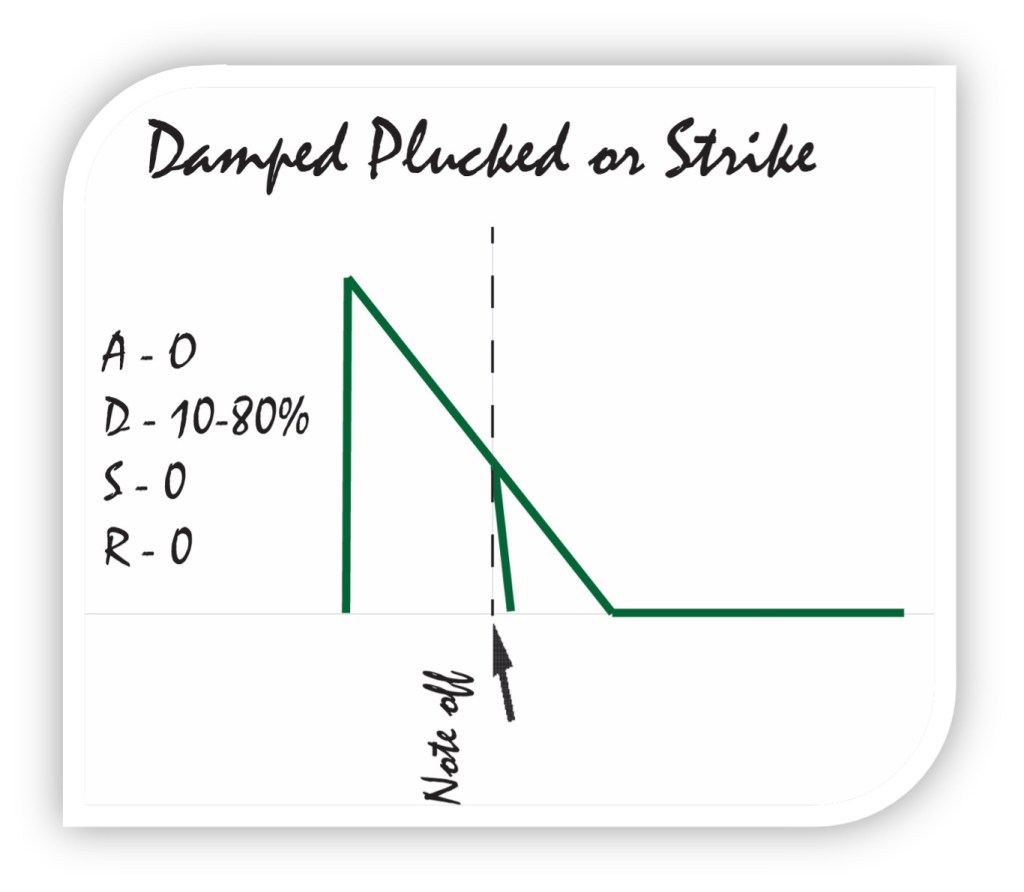
If I want to create a percussive sound I can create an Envelope where I set Sustain Level and Release Time to zero. That way I can control the sound only by a Decay Time. This Envelope is used for instruments that are plucked or hit, or with all instruments where energy isn’t added over the course of the note. We can create Damped percussive sound by increasing the Decay Time. It is great for emulating a piano for example. See Figure 3.
Picture: Figure 3
Thing to Remember
If you release the key in the middle of the Decay Phase, the Release Phase starts from that point.
Sustaining Envelope
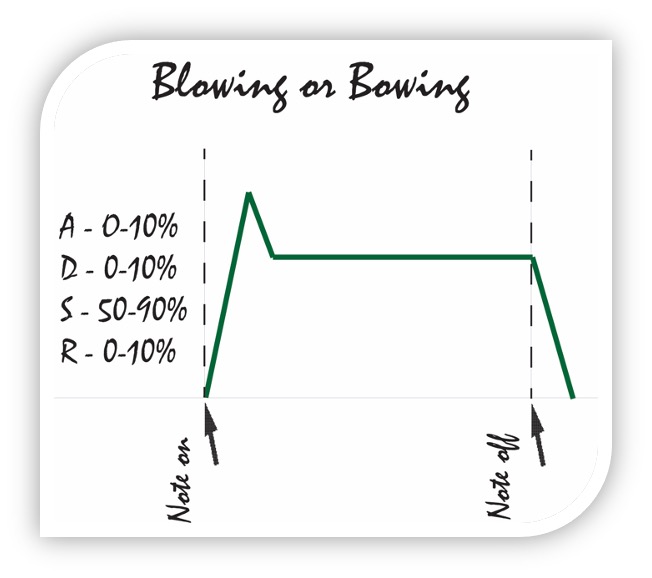
If we want to create that sort of sound, for bowing or blowing, we’re going to be using all the phases of the Envelope with very low Attack Time and Sustain Level somewhere in the middle. It is a standard diagram of an ADSR Envelope. This envelope can be used for trumpet, violin or bowing or blowing instruments. See Figure 4.
Picture: Figure 4
Quirk Envelope
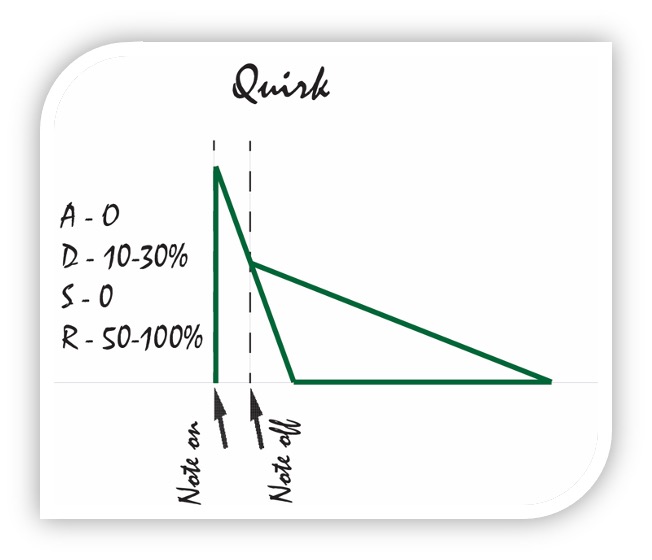
By setting Sustain Level all the way down, but Release Time very high and Decay Time very short we get Quirk Envelope. So we have no attack time. If you play a long note, you just get a short blip. But if you play very quickly on your keyboard, you get a long decay. This is happening because the release phase starts right when you release the key, no matter where the envelope is. So in this instance, if you play a short note, you get a long result, and if you play a long note, you get a short result. This Envelope could be used for some musical experiments. See Figure 5.
Picture: Figure 5

 Black Bat Records
Leave a comment