
Three letters. Many musical styles and their subgenres have their own three-letter abbreviations. How do you find your way around one specific underground part of electronic music? It’s not that complicated, read on and you’ll be in the know in a moment. EBM in a broader context falls under EDM. EDM stands for Electronic Dance Music. The abbreviation EDM covers electronic dance music in general. However, this abbreviation specifically refers to more commercial, mainstream dance music. For someone who has fallen for EBM, EDM as such can sound flat and largely recycled. EBM is an abbreviation for Electronic Body Music (Körpermusic in German) – music with an electronic body. Just as the body has its own structure – skeleton, muscles, organs, veins and arteries, so does this music. Mostly marching to militant drums in a four-quarter time (4/4 time), which complement dance-like repetitive electronic bass lines. These can sometimes be shifted an octave higher or lower. That’s the basis. EBM songs also contain vocals. This is what makes EBM different from predominantly instrumental EDM genres such as Techno or House, where there is often no singing. Another part of the body of the song is mostly synthesizer lines. Many older songs (80s/90s) use the so-called Dark Lubricant. Long, deep tones that evoke a gloomy atmosphere. Other synthesizer lines are placed higher and create additional layers of dance melodies. In EBM, you can really use anything. Some bands also have guitars that play mostly simple riffs and grooves (repeated dance elements). Hard rock or heavy metal solos are a great rarity, if at all. The singing is often punk or colloquial – declamation. It can also be with an overlap to old-school hip-hop with a little imagination.
Punk aesthetics are very close to EBM. Heavy boots, baggy pants, suspenders and a tank top underneath. These make the muscles stand out, especially if they are really sweaty from dancing. Mirrored hacker sunglasses and a militant hairstyle (an island of hair on the head, a kind of thicker and cut off clear at the back) complete the look of an EBM player. Black uniforms and overall military elegance are also very popular. However, many fans do not see it as a fashion show. A T-shirt of a genre band, whose owner is guaranteed to know more than 3 songs, is enough for them.
EBM culture falls under the Industrial scene. It also intersects with the Gothic scene. Today, everything has mixed up within the so-called Dark scene (dark scene in English, Schwarze Szene in German – where it means darkness). EBM can also be referred to as Cyberpunk, or at least a part of it.
The term EBM was first used by Ralf Hütter from the electronic band Kraftwerk in the November issue of the British music magazine Sonds in 1977. Interestingly, the band Kraftwerk does not actually belong to EBM, even though their compositions are heard in many EBM DJ sets. But that’s how it is with pioneers and visionaries. Kraftwerk later labeled their music Techno pop and at the beginning of their career they were considered Krautrock. Krautrock (from German cabbage rock) was an early designation of electronic music. Rockers looked down on it and that’s how it got such an initially derogatory name. Bands like Can, Tangerine Dream, or Amon Düül still have their fans among EBM fans today. Krautrock from Germany paved the way for EBM since the 1960s. Ideologically, the vast majority of EBM is strictly apolitical. And even though some bands express their views on the socio-political situation, they have a more metapolitical approach (Die Krupps – Fatherland, Deutsche-Amerikanische Freundschaft/D.A.F – Der Mussolini). Satire and provocation prevail in the lyrics. Some EBM bands are content to sing about work, dancing, heavy boots/muscles and parties. Other EBM bands focus more on the dark sides of human existence. EBM also includes sampling – the use of sound tracks from other works of art. And not only from them. Popular samples are political speeches, television news (Apoptygma Berzerk – Non-Stop Violence (CNN Version)), horror films (Skinny Puppy).
EBM originated around the beginning of the 1980s. Belgium, Germany, Great Britain, the USA and Canada are the countries where the EBM scene was formed. In Belgium, EBM was accompanied by Belgian New Beat (Praga Khan, Technotronic, Lords of Acid). It has a simpler structure, the emphasis is more on music than singing. It often contains scratching, which it borrowed from hip-hop. One of the first and fundamental Belgian EBM bands is Front 242. Pure EBM in its purest form. Militant look, two screaming vocalists, electronic pad drums and a few synthesizers or sequencers. From the other side of the Atlantic Ocean, it is Skinny Puppy from Canada. Dark and slower rhythmic songs, the singer sings as if he was gargling battery acid and jumping out of a horror movie. Dark, fear-inducing melodies and lyrics focused mostly on ecology and against the injustices of this world. Skinny Puppy’s music was grossly misused by the US government when they tortured prisoners in their Guantanamo prison in Cuba. The band successfully defended itself in court. They stated that they make music for people’s enjoyment and not as a torture instrument. From Britain, I would definitely mention NItzer Ebb. What does it mean? Actually, nothing, but it sounds like German. The band, with its early minimalism, is considered old-school EBM. In addition to fans of electronic music, they are also recognized among rap fans (the song Lightning Man, for example). From Germany, I would mention Deutsche-Amerikanische Freundschaft (DAF/D.A.F.). The band started as a guitar avant-garde, but it was the combination of minimalist synthesizer lines and pounding drums that made them a literal cult. The singer played a cassette with music at a concert, the drummer started playing and the singer recited a simple, repetitive text in a punk style. Their provocative song Der Mussolini was banned, but it is still played at almost every EBM or Gothic party. The text is strongly sarcastic, it has nothing to do with fascism. It points out how society is permanently manipulated. From American bands, I will mention Ministry. They started as a synthpop/EBM band and became a kind of American Rammstein by adding industrial guitars. In 2025, they returned to their early work. A similar fusion of EBM, Industrial and metal is played by two other bands, Die Krupps and KMFDM. But we are back in Germany.
When you search for EBM on the Internet, add music to the abbreviation. EBM also stands for Evidence Based Medicine. It also deals with bodies, just not electronic music ones. Industrial, dance music, noise music, rock and actually any can be mixed into the EBM pot. And here too, it happens that some bands play their own subgenre, others combine genres and specify their EBM position. TBM can be either Techno Body Music or Terror Body Music. What it is is clear from the separate name. Combichrist, for example, called their music TBM even before their metal phase. Progressive Body Music is the name of the debut album of the band BhamBhamHara, who also named what they play. They released two albums and no one else has continued to develop progressive body music yet. Harsh EBM/Hellectro/Aggrotech is a harder offshoot of EBM. It is also referred to as Harsh Industrila Dance. It is characterized by more industrial elements, higher tempo (although this is not necessary), rawer synthesizers, danceability and screamed vocals. These are often exaggerated through effects, especially vocal distortion. Nihilistic lyrics and BDSM aesthetics also belong to this subgenre. Horror and brutality, war and postapo. It strongly overlaps with Cybergoth or Industrial Rave. A noisier mannerism is Rhytm´n´noise which is based on machine beats supported by various noises – but we always stay in rhythm. Among the bands I can mention Suicide Commando, Feindflug, Hocico, Nachtmahr.
Oldschool EBM – this includes not only the bands that were at the birth of the genre, but also those that are returning to their roots. Typical examples are the Swedish bands Container 90, Spark! or the Austrian Sado-Sato or Muscles on Move. Oldschool EBM returns EBM back to its roots. Often, pairs of musicians jam on stage to sharp rhythms and simple undertones. Famielientreffen (family meeting) is the name of the Oldschool EBM festival held every year in the German town of Sandersleben. It is a treat for fanatics, other EBM fans may find it a bit boring after a while. And then it is the right time for another beer and hop back on the dance floor.
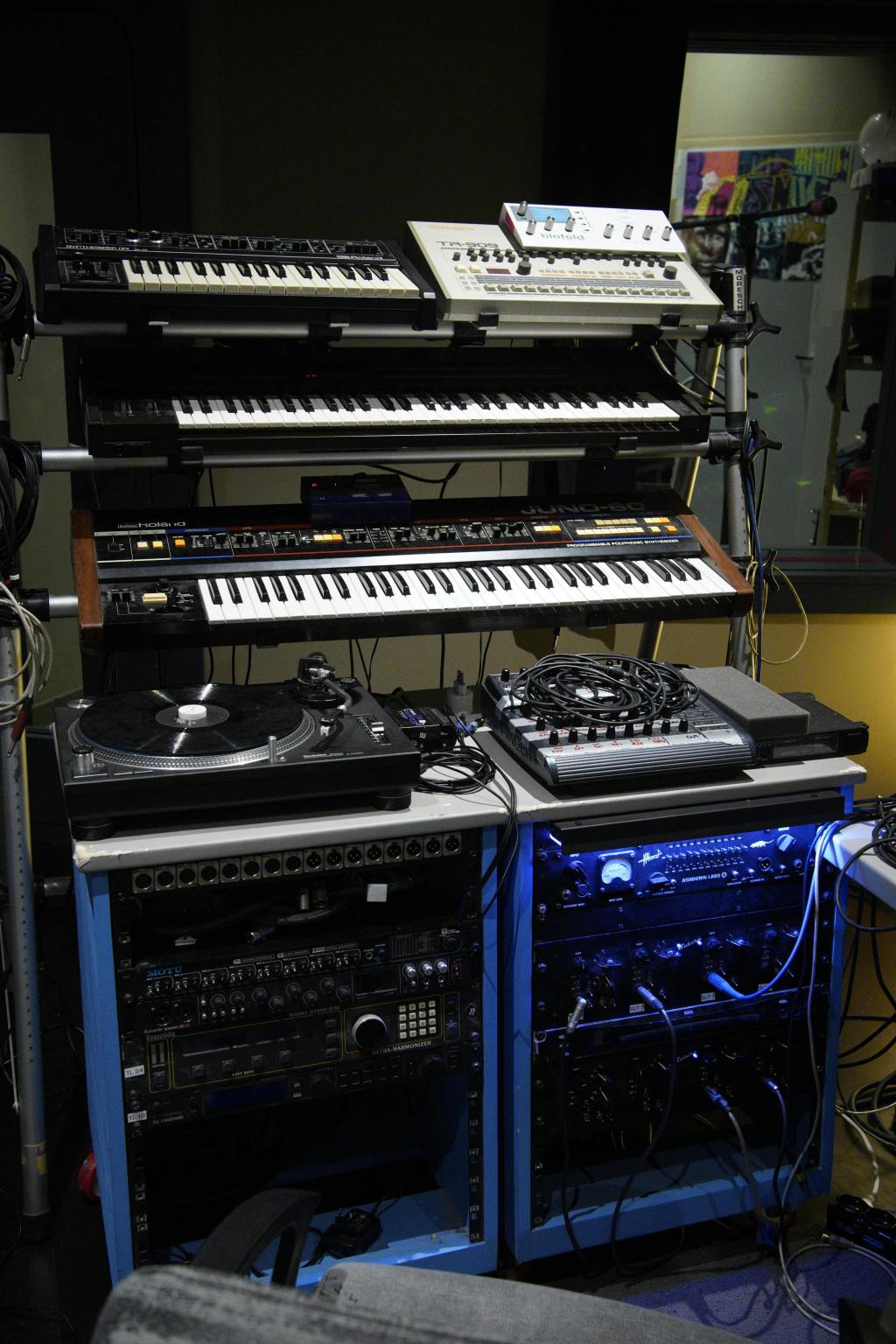
EBM music originated in the days when computers as we know them today did not yet exist. Until now, many bands have used various analog equipment. In particular, synthesizers, sequencers, drum machines, effects. EBM has always been an innovative genre by its very nature, as it directly depends on the development of musical technology. Kraftwerk made many electronic instruments themselves. Some of the first software for composing or better programming music appeared on microcomputers such as the Commodore 64 (the predecessor of desktop personal computers (PC)). Many EBM musicians are also programmers. To this day, the German band Welle:Erdball still considers Commodore 64 a member of the band. They have their own retrofuturistic concept. Many EBM bands have their own concepts. As a curiosity, I would also mention Heimataerde – medieval EBM :). Or Die Selektion, whose music is decorated with a trumpet. Since the EBM scene is integrated into the dark scene and is very strongly connected to Industrial, many bands play a mixture of similar genres. The same goes for labels. Where you can definitely find quality EBM are labels such as Alfa Matrix, COP International, Metropolis Records, Wax Trax! Records, Dependent Records, Gun Records, Infacted Recordings, Trisol Music Group,… Even if some no longer exist, their catalogs are mostly owned by other labels. And with the help of the internet, you can get almost everything these days. Finally, I would like to mention Electronic Body Movie (2024). The hour-long documentary maps the birth of the genre through interviews with musicians and samples of their music. It focuses on Belgium, Germany, and Great Britain. Mainly because of its short length, it leaves out the American continent as well as the rest of Europe and the world. But that doesn’t matter. It is guaranteed to please beginners as well as seasoned EBM fans.
Author

Dr. Love
Electronic music producer, DJ, cameraman, photographer and art enthusiast of various kinds. Made in 1985, graduated as a graphic designer, cameraman, editor and director. Music is his great passion. He got into industrial and various other styles of the alternative music, so-called dark scene, through punk and techno.
 Black Bat Records
Leave a comment